

Lehmann Stirlingmotor
Bis 1850 hatten England, Amerika und Frankreich der Welt mehrere bemerkenswerte Heißluftmotoren präsentiert. Überraschenderweise hatte Deutschland bis zu diesem Zeitpunkt keine nennenswerte Innovation auf diesem Gebiet hervorgebracht, und erst 1867 kam dieses Land mit einer bedeutenden Neuerung im Bereich der Heißluftmaschinen auf. Eine späte Innovation, aber eine beeindruckende: der Lehmann-Luftexpansionsmotor!
Diese Heißluftmaschine oder, wie ihr Erfinder sie treffender nannte, die "Luftexpansionsmaschine", wurde vom deutschen Ingenieur Wilhelm Lehmann aus Nürnberg im Jahr 1867 entwickelt und auf der Weltausstellung in Wien 1873 ausgestellt.
Dieser Motor wurde schnell zu einem großen Erfolg in ganz Europa, besonders in den deutschsprachigen Ländern. Wie Alfred Musil 1875 schrieb: "Lehmanns Heißluftmaschine ist die älteste und auch die am weitesten verbreitete der derzeit renommierten Konstruktionen."
Wilhelm Lehmann, Erfinder eines der beliebtesten und angesehensten Heißluftmotoren der 1860er Jahre, ist vollständig in Vergessenheit geraten. Sein Name ist verloren gegangen, versteckt in den Gräben der Geschichte. Glücklicherweise bieten einige ausgezeichnete Archive einen tiefen Einblick in eine der besten jemals hergestellten Heißluftmaschinen.
Auch heute noch ist der Stirlingmotor unter den technischen Modellbauern sehr beliebt der Lehmann Stirlingmotor hat eine interessante Hebelkulisse. Wenn der Motor läuft ist diese Hebelkulisse sehr beeindruckend.

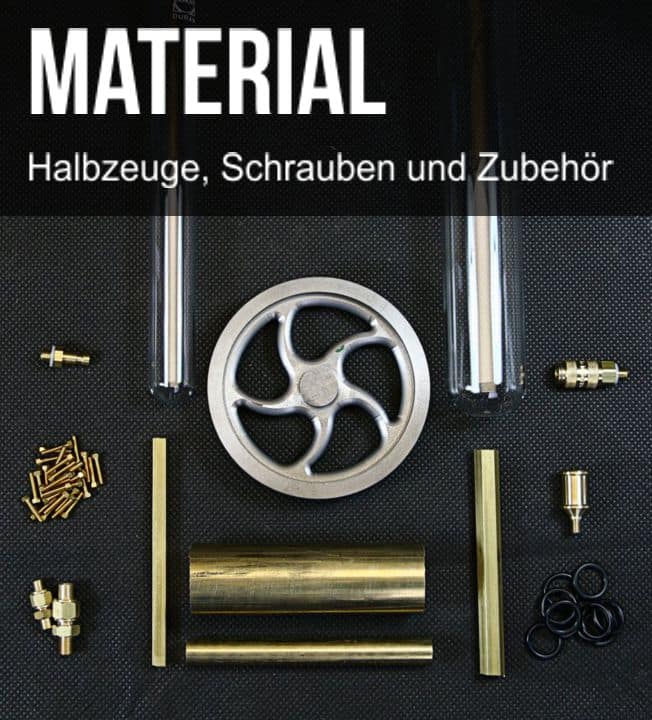
The original Britain, America and France had introduced several notable hot air engines by 1850. Surprisingly, Germany had not produced any significant innovations in this area up to this point, it was not until 1867 that the German Wilhelm Lehmann produced a significant innovation in the field of hot air machines. A late innovation, but an impressive one: the Lehmann air expansion engine!The model Stirling engine Rainer The model of the Lehmann Stirling engine has a total length of 285 millimeters. When designing our Stirling engine, we tried to keep it as close to the original as possible. However, it is not a 100% copy of the original. Our model is operated with an alcohol burner. The burner is firmly screwed to the oak base plate. The cooling jacket, which was a solid casting in the original, is assembled from several milled brass parts and soft-soldered. Just like the original Lehmann Stirling engine, the model has a functional centrifugal governor that can regulate the speed of the hot air machine. As with the original, the centrifugal governor opens a valve that allows the air in the Stirling's working chamber to escape. The 140 mm diameter flywheel is made from a very clean cast steel. In addition, the Stirling engine has a 48mm pulley that could be used to drive small drive models, for example.Speed control via centrifugal governor This Stirling engine has a working centrifugal governor. When the speed is sufficient, the balls of the regulator rise. This moves a lever that operates a valve. If the valve is opened, the working air can escape from the displacement cylinder. Due to the reduced pressure, the Stirling process no longer works optimally and the engine reduces its speed. To set the desired speed, you can adjust the spring tension of the valve using a handwheel during operation.Dimensions of the model Stirling engine Base plate: 255mm x 120mm Flywheel: 140mm Pulley: 48mm Total height: 210mm Working piston: 28mm Displacer piston: 25mm Length overall: 285mmThe “Rainer” Stirling engine material kit is included in delivery Wooden base plate Finished milled parts Brass, steel, stainless steel and silver steel Raw material for the turned parts Cylinder sleeve made of precision tube flywheel All required screws, nuts, gaskets, grub screws and wick Construction plan model Stirling "Rainer" drawings (14 sheets) and construction instructions (9 sheets)