

Internal combustion engines
Under this section you will find material kits for model combustion engines. The combustion engine kits are constructed in the same way as our other kits. All milled parts have already been milled by us. All turned parts are included as raw material sections. Of course, the kit includes all the necessary screws, nuts, ball bearings , seals and especially in the kits for model building stationary engines also all the parts required for ignition such as: breaker, Spark plug or Ignition capacitor. So that if you decide to build a kit from Bengs Modellbau, you will have all the parts to build a working and running model combustion engine in your workshop.
We have a small model, Combustion engine "Little Karl" which is also suitable for beginners in technical model making. The Karl stationary motor is suitable for model makers who have a lathe that can machine a 140mm flywheel.
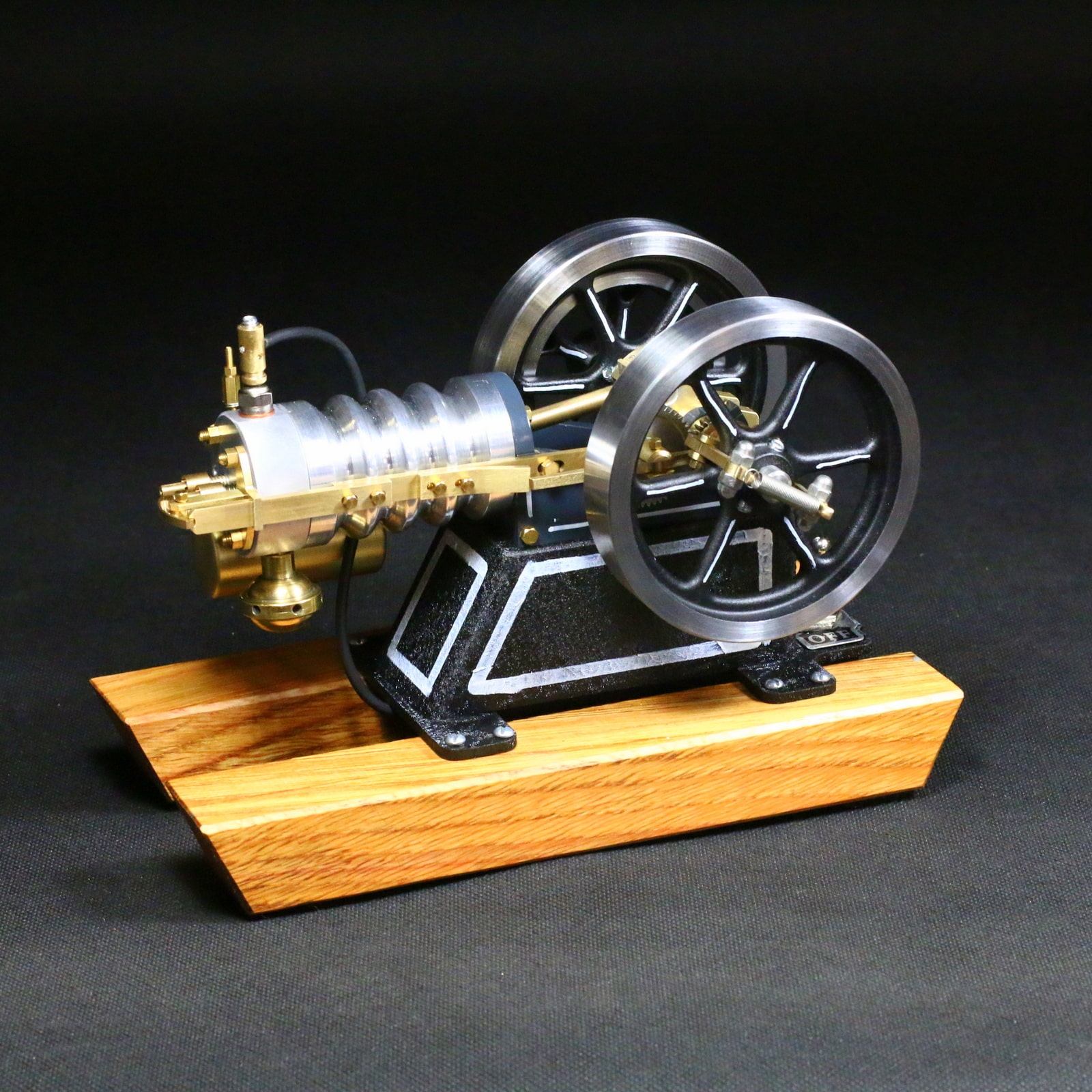
The combustion engine “Little Karl” is, as the name suggests, the small version of our popular combustion engine Karl. With this kit, particular emphasis was placed on the fact that it can be made in a small hobby workshop with a small lathe. Thanks to its simple construction, this model is also suitable for beginners in technical model making. In contrast to the large stationary engine Karl, this model does not have an ignition with a spark plug but rather a Glow plug. This circumstance makes both the construction of the model and its operation easier because the ignition timing does not need to be adjusted. Of course, this model also has speed control via Hit & Miss control. The combustion engine “Little Karl” with glow plug has a stable frame made of milled brass parts. The crankshaft is guided in two gunmetal plain bearings. The cylinder sleeve consists of a precision brass tube that no longer needs to be processed inside. An aluminum piston runs in the tube. The cylinder head and cooling jacket are also made of aluminum. Most other components such as the carburettor, tank, rocker arms and controls are made of brass. The entire motor is mounted on an aluminum base which in turn rests on two oak wooden runners. The two 80mm flywheels and the pulley are made of cast steel using the lost wax casting process and are of excellent quality. All materials required to build the combustion engine "Little Karl", such as screws, springs and ignition parts, are included in the kit. All milled parts are prepared so that they only need to be deburred and possibly drilled. All turned parts are included in the kit unmachined and must be manufactured according to the drawing. To build the Hit & Miss Motors requires a small lathe, a drill and a gas burner for soft soldering. The following hand tool is also required (tap M2, M3, M4, tap UNEF1/ 4 x 32, Dies M4, M6, reamer 3H7, 5H7, 6H7, 8H7) files and a drill set are necessary. All you need to wire the glow plug is a pair of side cutters, wire strippers and a soldering iron. You also need a baby battery with at least 3000 mAh. The battery is not included in the kit but can be ordered from us. If you would like to find out in advance which work steps you have to carry out when manufacturing this combustion engine, take a look at our Bengs model building magazine Construction report of the combustion engine "The Little Karl" with glow plug. On this page you can see the illustrated report on how the stationary motor material set is processed. Dimensions of the model combustion engine 'Karl': Height with wooden runners: 135mm Length overall: 200mm Width overall: 120mm Length without runners: 190mm Piston diameter: 20mm Flywheel D.: 80mm Speed: 600-1500 rpm Weight of the finished model: 1.8kg Hit & Miss Regulation With the hit & With this control you can limit the maximum speed of the engine. If the engine has reached too high a speed, a slide prevents the exhaust valve from closing. This means the engine runs freely. No compression can occur in the cylinder chamber and the engine neither sucks in fresh gasoline nor ignites the air-fuel mixture. The Hit & Miss regulation is called suspension regulation in German. The misfire control was mainly used in the USA by various companies for internal combustion engines from 1890 to 1940. The scope of delivery includes: finished CNC milled milled parts Raw material for the turned partsRough casting part for the flywheels 80mm Raw casting part for the belt wheel Two wooden runners made of oak All required screws, nuts, gears and sealing rings Drawings of the combustion engine "Little Karl" (24 sheets) and construction instructions (11 sheets) Switch, battery compartment, cable and glow plug (Battery Baby battery not included is available from us
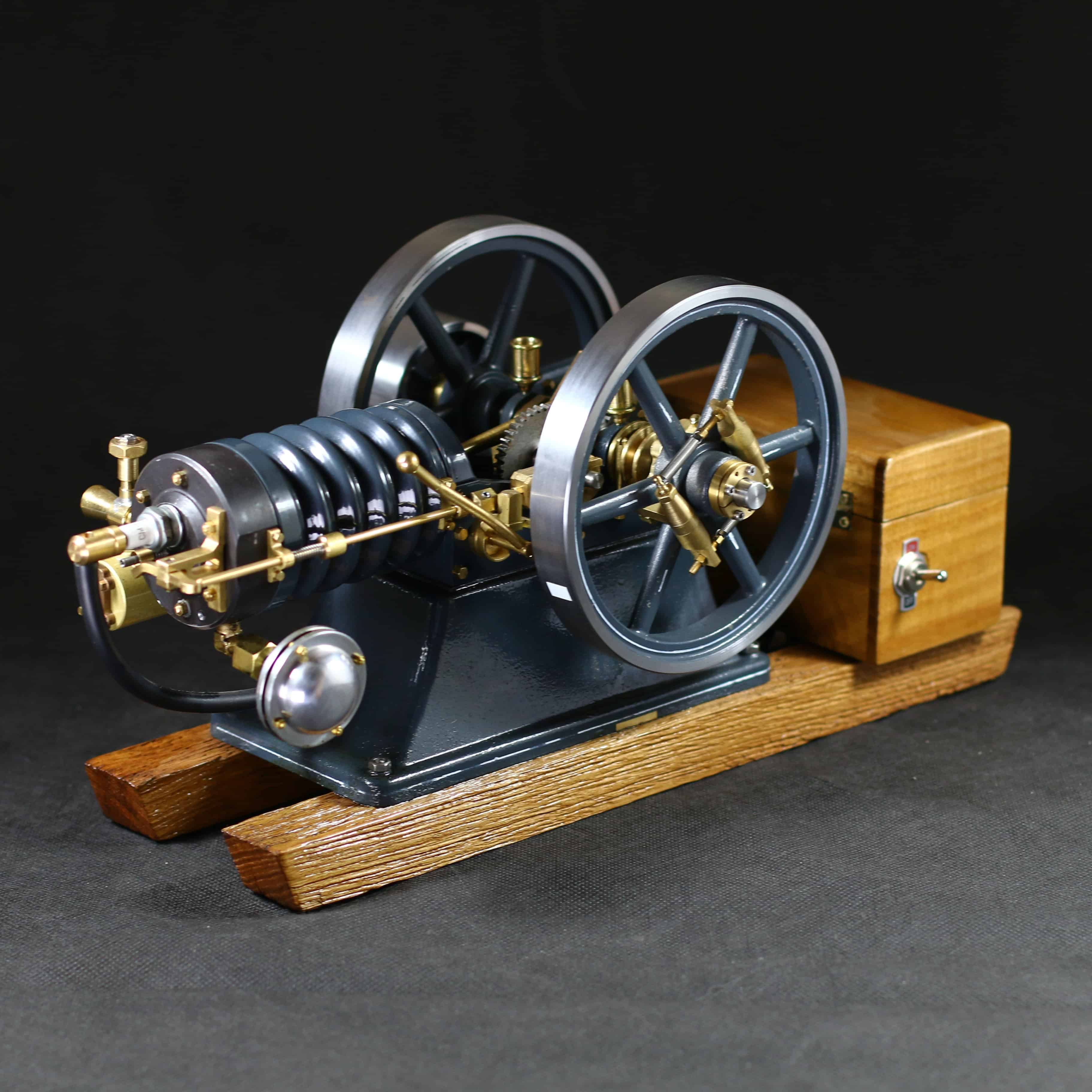
Available again from October 2025 If you're interested, feel free to contact us – we’ll gladly reserve a motor kit for you without obligation. Stationary engine with hit and mismatch were used from 1890 to 1940 for a variety of tasks. The design with lying cylinder, open crankshaft and two flywheels was one of the most popular. These engines have been used in many farms to drive threshing machines, pumps, or grain grinders. But also in many craft and industrial engines, these combustion engines have been used in various sizes. Particularly in the American area, the speed control system has been widespread through a misfire control. The open crankshaft and the open rocker arms allow a very good view of the workings in an internal combustion engine. With the material kit for the internal combustion engine "Karl" you can build a fully functional combustion engine. The material kit contains all required parts including the ignition. The engine has a functioning speed control, which is controlled by a hit and miss misfire control. The ignition is concealed in the base of the machine, as well as in the wooden box behind the machine base. Dimensions of the model internal combustion engine 'Karl': Height with wooden runners: 192mm Overall length: 440mm Width overall: 180mm Length without skids and wooden box: 283mm Dia. Piston: 25mm Flywheel D .: 140mm Speed: 600-1500 rpm The machine foot of the station motor is a heavy gray cast iron base. The piston of the machine is also made of gray cast iron round material. The cylinder is made from a hydraulic cylinder tube which is already finished on the inside and has an excellent surface. The cylinder head and cooling jacket are made of aluminum to guarantee good heat dissipation. The flywheels are made of cast steel in the usual Bengs model construction quality. Most attachments and machine frames are made of brass. All necessary materials for the construction of the internal combustion engine "Karl" Screws, springs and ignition parts are included in the kit. All milling parts are prepared so that they are only deburred and possibly drilled. Construction of the Hit & Miss engine requires a lathe, a drilling machine and a gas burner for soldering. Furthermore, the following hand tools still needed (taps M2, M3, M4, M8x0,75, M10x1 Dies M2, M3, M4, M8x0,75, M10x1 Reamer 3H7, 4H7 6H7, 10H7) files and a set of drill bits needed. Only one side cutter requires a stripping plier and a soldering iron for wiring the ignition. If you want to find out in advance what steps need to be performed in the production of this engine that you see in our Bengs model magazine the building report from the 4-stroke stationary engine "Karl" on. On this page you can see the illustrated report how the station motor is edited.Included in the delivery are: Finished CNC milled milling parts Raw material for the turned parts Raw casting for the flywheels Raw casting for the belt pulley Two wooden runners All required screws, nuts, sprockets and ball bearings Drawings Internal combustion engine "Karl" (24 sheets) and english construction manual (11 sheets) Wooden box for ignition Ignition coil, condenser, spark plug and breakers All required cables for the ignition Power supply for the ignition Hit & Miss regulation The Hit & Miss regulation can limit the engine's maximum speed. When the engine has reached an excessive speed, a slider prevents the exhaust valve from closing. Thus the motor runs freely. No compression in the cylinder chamber can occur and the engine does not suck up any fresh gasoline or ignite the air fuel mixture. The Hit & Miss regulationt is mentioned in the German suspension rules. The intermittent control system was used from 1890 to 1940 mainly in the USA by different companies with internal combustion engines.
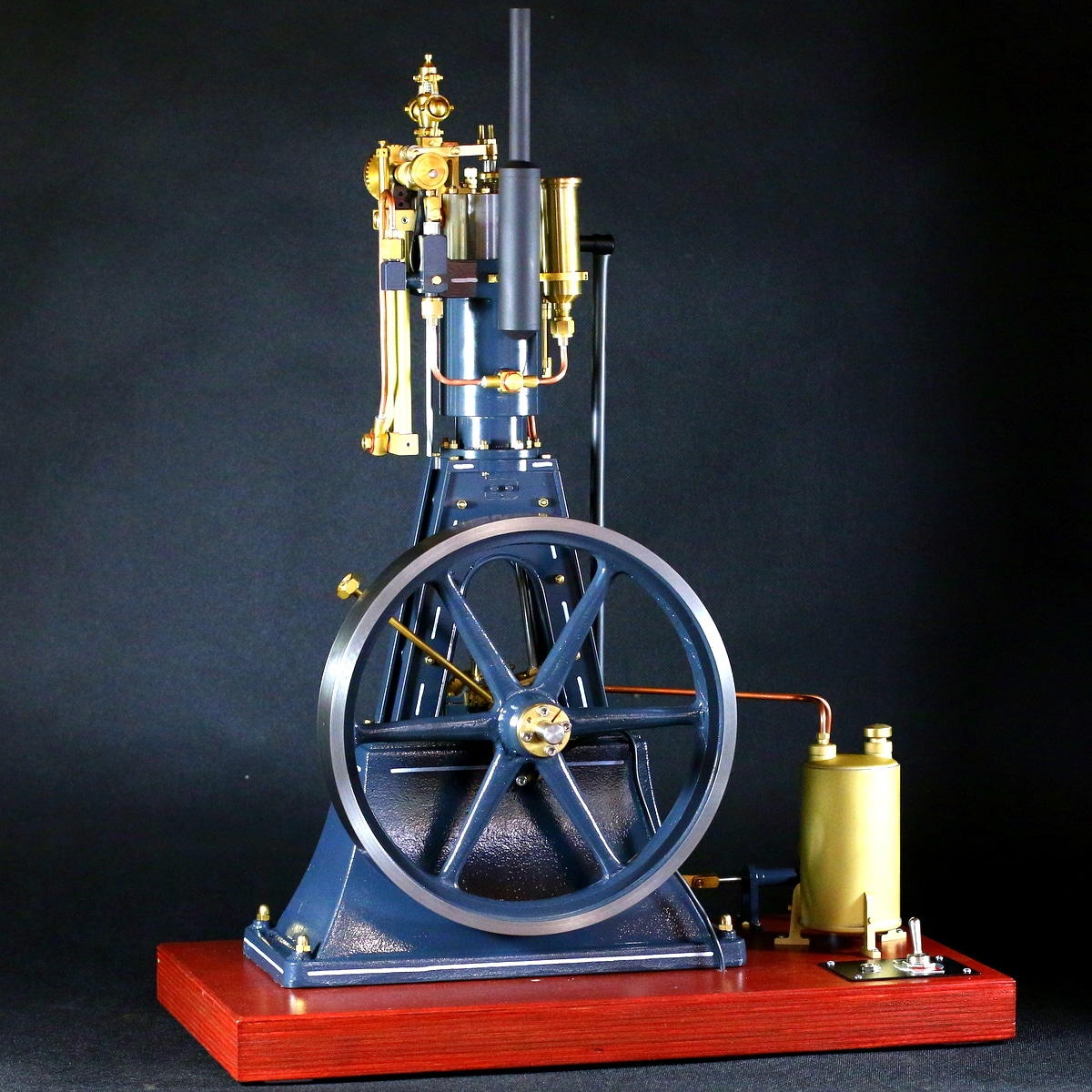
The Jonas vertical combustion engine was based on the appearance of the early diesel engines that were created at the beginning of the 20th century. A frame that has the shape of an A was typical. In addition, the early diesel engines were mostly long-stroke engines, which resulted in a slim and tall design. The overhead camshaft, which was driven by a long vertical shaft, was also typical. Back then, as now in our model, the speed was controlled via a centrifugal governor mounted on top of the vertical shaft. Our combustion engine runs on gasoline, but operation on diesel is not possible. Speed control via centrifugal governor Carburetor with adjustable throttle valve Cooling circuit with cooling water pump Fuel pump delivery rate adjustable Ignition timing adjustment Camshaft drive via screw wheel 45° With the material kit for the water-cooled 4-stroke engine "Jonas" you can build a fully functional internal combustion engine yourself. The material kit contains all the necessary parts including the ignition. The engine has functioning speed control using a centrifugal governor. A cooling water pump pumps water through a radiator into the cylinder jacket and back again. The engine also has a fuel pump that pumps the fuel towards the carburettor into an intermediate tank. The pumping volume of the fuel pump can be adjusted as required. The breaker ignition is located in the cast base. The ignition is supplied with voltage via a 12 V 2 A power supply. The power supply is also included.Dimensions of the model combustion engine 'Jonas': Height with wooden base: 500mm Dimensions of the base plate: 350mm x 210mm Piston diameter: 25mm Flywheel D.: 200mm Speed speed: 200-600 rpm Weight: 11.8kg The machine base of the vertical stationary motor is a heavy gray cast iron base. This heavy base gives the model sufficient stability. The piston of the combustion engine is also made from gray cast iron round material. In this engine the piston also has a piston ring. The piston ring is already included in the kit. A hydraulic cylinder tube is used as a cylinder, which is already finished on the inside and has an excellent surface. The cylinder head is made of aluminum, the cooling jacket is hollow and is flushed with cooling water via a cooling water pump. The 200mm flywheel is made of gray cast iron and can be ordered pre-machined upon request. Most of the attachments and the machine frame are made of brass.Speed control The speed of this model is controlled via the carburettor. By being able to regulate the amount of air supplied. The carburettor is connected to a centrifugal governor via a linkage. This means you can set the engine to a desired speed and this is maintained even under load using the centrifugal governor. All materials required to build the internal combustion engine "Jonas" screws, nuts, springs and ignition parts are included in the kit. All milled parts are prepared so that they only need to be deburred and possibly drilled. To build the vertical stationary motor, you need a lathe, a drill and a gas burner for soft soldering. The following hand tools are also required (tap M2, M3, M4, M6x0.75, M8x0.75, M10x1 die M2, M3, M4, M6x0.75, M8x0.75, M10x1 Reamer 3H7, 4H7 6H7, 8H7, 10H7) Files and a drill set are necessary. All you need to wire the ignition is a pair of side cutters, wire strippers and a soldering iron. If you would like to find out in advance which work steps you have to carry out when manufacturing this combustion engine, take a look at our Bengs model building magazine Construction report of the vertical stationary engine “Jonas” at. On this page you can see the illustrated report on how the stationary motor material set is processed.The scope of delivery includes: finished CNC milled milled parts Raw material for the turned parts Raw casting part for the flywheel (optionally also completely turned) Base plate birch multiplex Cylinder sleeve
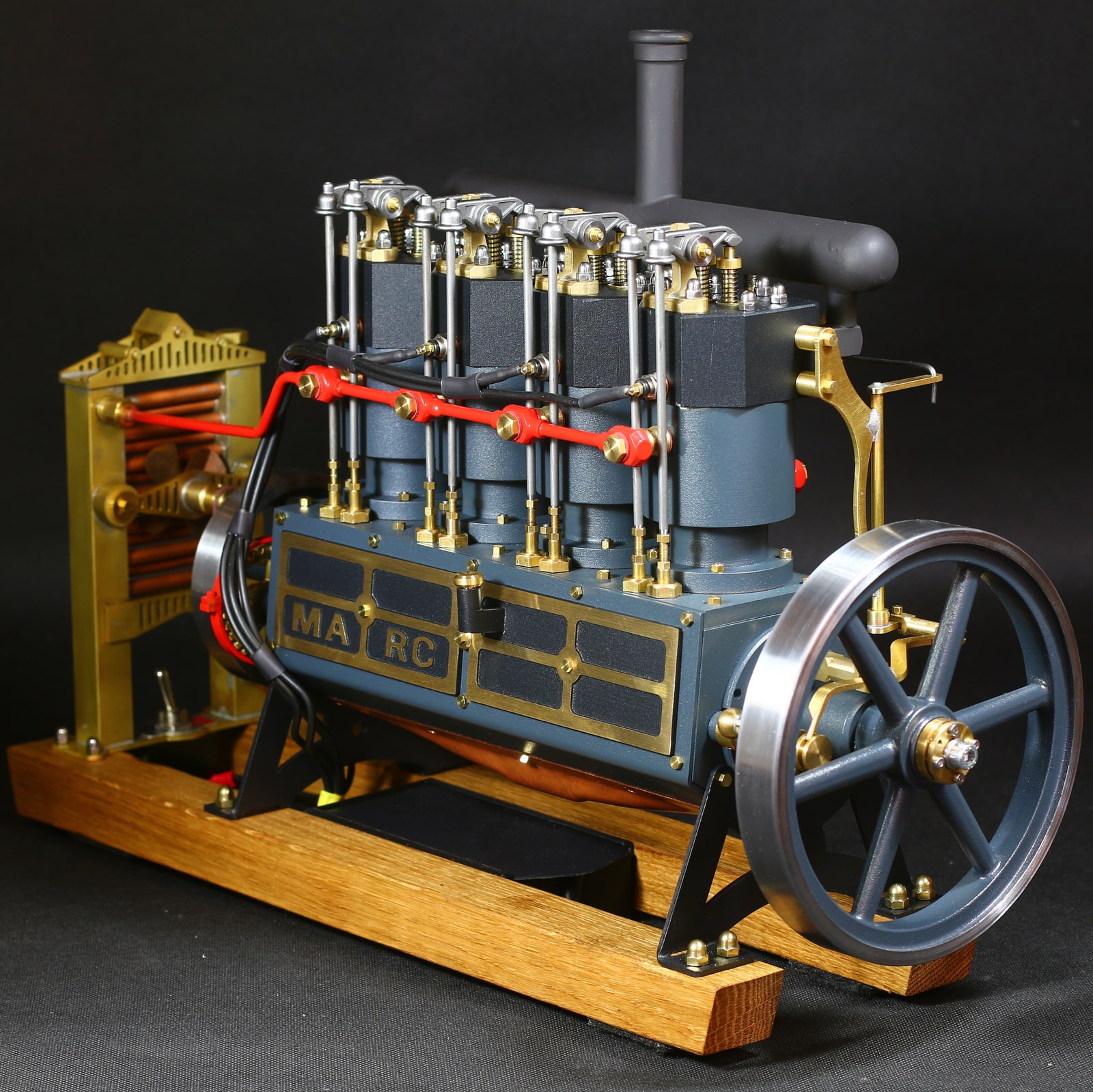
The 4-cylinder in-line engine "Marc" is based on a historical model. The model was a four-cylinder in-line engine that was manufactured by the American company Holt at the beginning of the 20th century. This engine was mainly used in bulldozers and tracked tractors. This engine was available in 2, 4 and 6 cylinder versions. In 1925, the Holt company became the Caterpillar company, which still exists today. The engine does not consist of a cast engine block, as was usual later, but still has individual cylinders. This design is visually very appealing and makes it possible to offer the engine as a material kit. Speed control via centrifugal governor Carburetor with adjustable throttle valve Cooling circuit with cooling water pump Cooler with fan With the 4-cylinder in-line engine "Marc" material kit, you can build a fully functional combustion engine yourself. The material kit contains all the necessary parts including the ignition. The engine has a functioning speed control using a centrifugal governor. A cooling water pump pumps water through a radiator, where the cooling water is cooled down by the fan and then flows back into the cylinder jacket. The engine is equipped with glow plugs. The glow plugs come with four Batteries operated. All components for producing the ignition are included (batteries are not included).Dimensions of the model combustion engine 'Marc': Height with wooden base: 310mm Length: 450mm Width: 180mm Piston diameter: 23mm Flywheel D.: 1x140mm 1x80mm Speed speed: 200-1000 rpm Weight: 9.1kg The engine stands on two oak runners. The engine block is screwed together from milled parts. The base plate for the cylinders is made of steel, the bearing blocks that hold the crankshaft are made of aluminum. This unit is then provided with finished lasered and folded sheets. The cylinder sleeves are made of brass, the inside diameter no longer needs to be machined. The cylinder head and cylinder are included as material sections and must be machined on the lathe. The remaining components are mainly made of brass. The crankshaft is made from individual segments. No milling machine is required to produce the crankshaft either. It can be built entirely on the lathe. Further information can be found in our build report for the four-cylinder engine. The two flywheels are available in the quality we know. Both flywheels are made of cast steel. The speed of this model is controlled via the carburettor. You can regulate the amount of air supplied. The carburettor is connected to a centrifugal governor via a linkage. This means you can set the engine to a desired speed, which is then maintained under load using the centrifugal governor. Here you will find an extensive construction report of the four-cylinder internal combustion engine Marc< /a> with lots of pictures and additional texts. Here you will find extensive assembly instructions for the combustion engine On the page you can see how you have to put all the manufactured parts together. Here you will find extensive instructions for the Commissioning and operation of the four-cylinder engine Marc All materials required to build the internal combustion engine "Marc" screws, nuts, springs and ignition parts are included in the kit. All milled parts are prepared so that they only need to be deburred and possibly drilled. To build the vertical stationary motor, a lathe, a drill and a gas burner for soft soldering are required. The following hand tools are also required (tap M2, M3, M4, M5, 6x0.75, M8x0.75, M10x1 die M2, M3, M5, M6x0.75, M8x0.75, M10x1 reamer 4H7 6H7, 8H7, 10H7) Files and a drill set are necessary. All you need to wire the ignition is a pair of side cutters, wire strippers and a soldering iron. If you would like to find out in advance what steps you will take to make this internal combustion enginehave to be carried out, take a look at the construction report of the 4 cylinder combustion engine "Marc" material kit in our Bengs model building magazine. On this page you can see the illustrated report on how the stationary motor material set is processed.The scope of delivery includes: finished CNC milled milled parts Raw material for the turned parts Rough casting part for the flywheels 2 runners made of oak wood All required screws, nuts, gears and seals Drawings of the internal combustion engine "Marc" (36 sheets) and construction instructions (8 sheets) Glow plugs, cables, cable clamps, battery compartment for the ignition Laser parts for stands and fairings
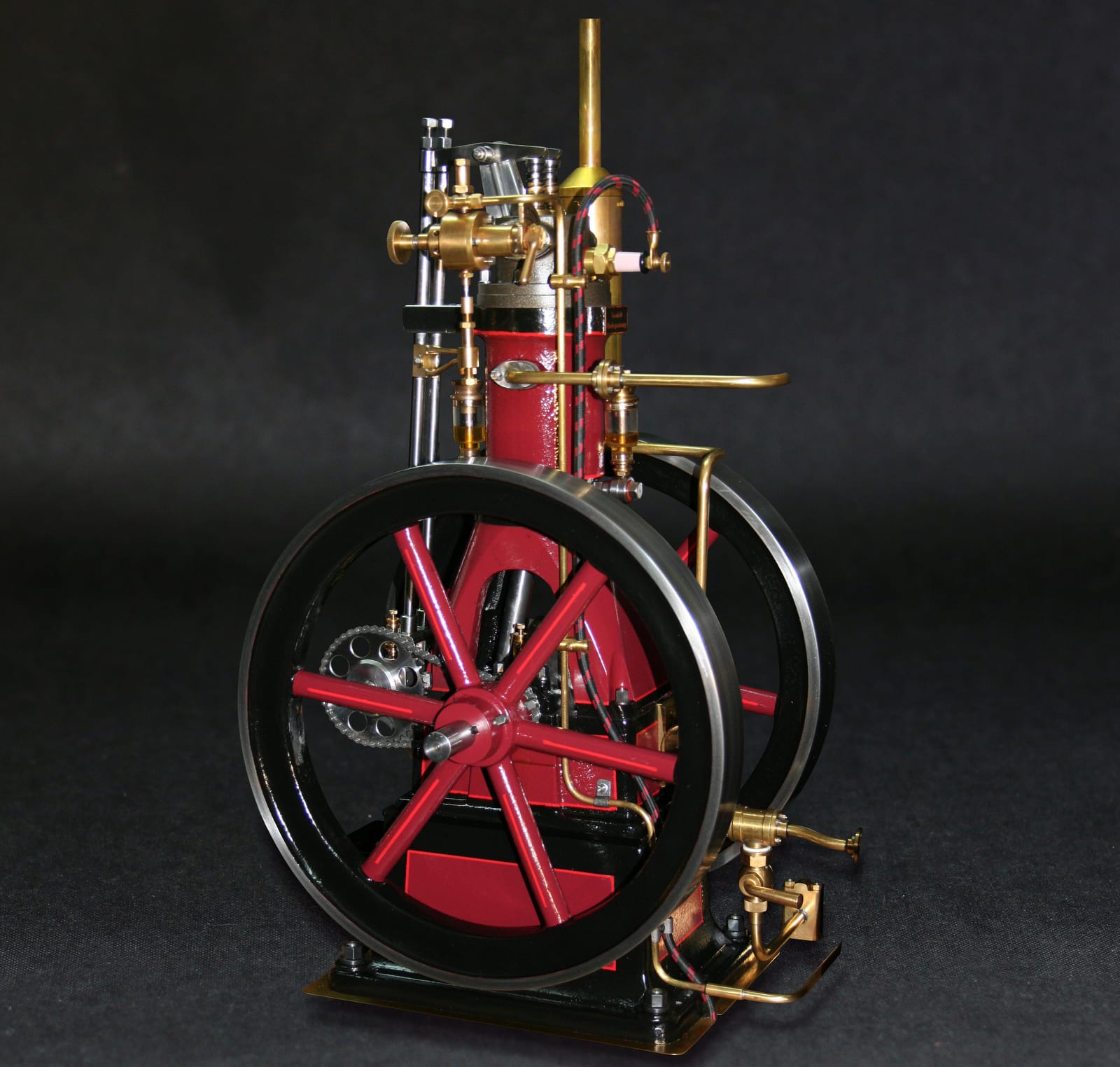
With this set of cast parts you have the opportunity to build a prototypical model engine of the type that was used as a large engine at the beginning of the last century (e.g. to generate electricity in factories). The large piston stroke and large bore enable a speed of less than 130 rpm. The quiet and slow running of the engine arouses true enthusiasm among connoisseurs. The valves are controlled via a timing chain that drives the camshaft. The dimensions of the gas engine are already clear from the weight. It weighs around 50 kg. With this engine, a true-to-life power plant can be built to generate electricity. This set of castings was previously sold by the Ravensburger Dampfmodelle company. This casting set, drawing and spare parts are now available from us in the Bengs Modellbau online shop. We supply most of the special parts needed to build the engine. You can use the components we offer as ignition. Here you can find the parts for the ignition (Ignition coil , Interrupter, Kondensator, Spark plug). The castings are molded and cast by hand in a small foundry in Germany. Most of the castings are made of GG25, the cylinder head is delivered in cast aluminum. Due to the large dimensions of this engine, you should have an excellently equipped workshop with a large lathe and a large milling machine. Here you will find a detailed construction report from the Otto gas engine vertical in our magazine. Technical data Vertical gas engine Otto V Power: approx. 0.7/0.5 HP/kW Speed speed: approx. 130 rpm Bore/stroke: 50/80 mm Displacement: 150 cc System: Otto Ignition: battery ignition Fuel: Gas Lubrication: Drip oiler Flywheel Ø approx. 350 mm Flywheel width: approx. 42 mm Shaft width: approx. 300 mm Motor height: approx. 600 mm Flywheel: approx. 20 kg weight Scope of delivery: cast parts Base / GG25 Base / GG25 Cylinder / GG25 Bearing block / GG25 Bearing cap / GG25 2x flywheel / GG25 Cylinder head / cast aluminum Includes small parts Drawing Sprocket 1 / steel Sprocket 2 / steel Liner for cylinder 2x piston rings 2x valve springs Steel roller chain Chain lock
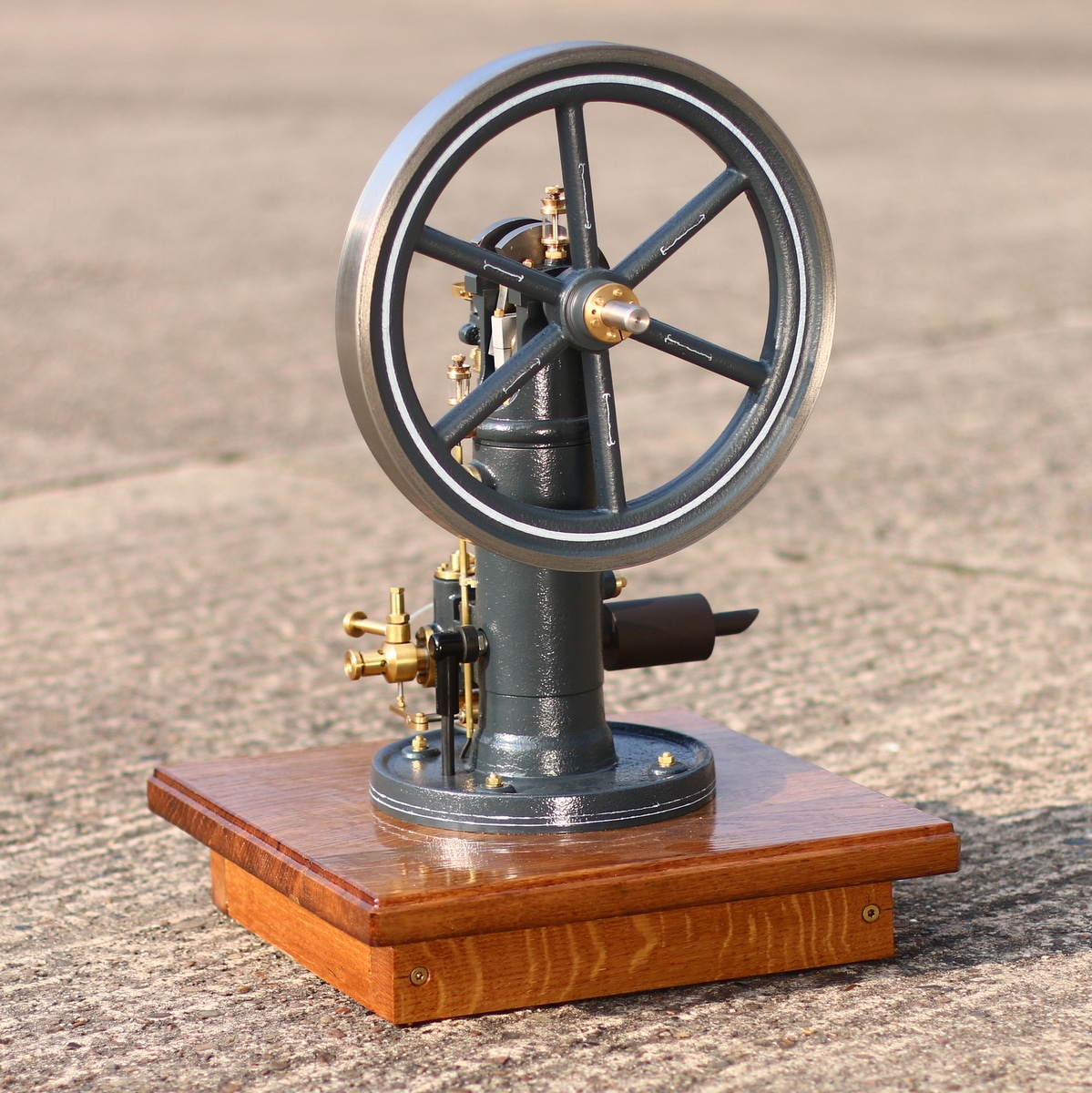
This casting set was designed on the model of a Dürkopp gas engine. The finished model has an impressive total height of 430mm and many special details. This casting set was previously marketed by Ravensburger steam models. From now on this cast kit is available from us. To build this casting set, you should already have experience in this model construction area. The flywheel with 280mm diameter requires a large and stable lathe, with a sufficiently large lining and planar disc. You also need a larger milling machine to finish the castings. This engine is a special construction, the crankshaft lies above and the piston plunges down into the cylinder. This type of motor is called the plunger motor. A cam disk is driven via two bevel gears, through which the inlet and outlet valves are actuated. The valves are not mounted in the cylinder chamber, as are customary today, but are located outside in their own valve housings. In addition, this motor is equipped with a centrifugal governor, which can be used to regulate the amount of the incoming gas. The Dürkopp immersion piston engine has been designed for operation with gas. It can be operated directly with gas from a propane bottle. Of course, this engine can also be operated with petrol. For this, however, the gas mixer must be exchanged for a carburettor. Our experience has shown that this engine runs with gas much smoother and more beautiful. We recommend operating with gas. Required tools and machinesFor the construction of the combustor, an extensive workshop, with a large lathing machine and a medium-sized stable milling machine is needed. The lathe should be able to machine a flywheel with an outer diameter of 300 mm. For machining the castings on the lathe, a planar disk should also be present. In addition, a stator drilling machine and a torch for soldering larger parts will be available. Furthermore, hand tools (taps M2, M3, M4, M6x0,75, M10x1 / cutter M2, M3, M4, M8, M6x0,75, M10x1 / reamers 3H7, 4H7, 5H7, 6H7,15H7 files, drill set) are necessary , To solder the ignition, a soldering iron is required for this model. We have prepared for you an extensive construction report of the Dürkopp gas engine. The building report is subdivided into subassemblies and is designed to assist you in the manufacture of the engine. Furthermore, you can see in the building report whether your machine park is of sufficient size. Baubericht Dürkopp Tauchkolben Gasmotor Dimensions of the finished engine: Height: 430mm Thrust Gusssockel (cylinder head): 195mm Diameter of flywheel: 290mm Diameter of piston: 40mm Piston stroke: 60mm Weight with wooden base: 20kg You have the choice between 4 different variants. You have the choice between different sets of gasmotor Dürkopp. With Set 2 you get the drawing, the cast parts and some special parts. If you order Set 4 you will get all the components and screws needed to build the engine. With Set 4 everything from the piston to the power supply is there and you do not have to leave the hobby workshop until the completion of the engine. Dürkopp vertical Gas engine Set 1 / Construction Plan Construction plan Dürkopp Gasmotor consisting of drawings (3 sheets DIN A3, 22 sheets DIN A4 Dürkopp vertical Gas engine Set 2 / Construction Plan, cast parts Construction plan Dürkopp Gasmotor consisting of drawings (3 sheets DIN A3, 22 sheets DIN A4) Cast iron (1x flywheel 280mm, 1x cylinder head with foot, 1x cylinder jacket, 1x crankshaft bearing block, 2x bearing cover, 2x valve housing,) Special parts 40mm cylinder tube, piston rings, bevel gears Dürkopp vertical Gas engine Set 3 / Construction Plan, cast parts, screws and ignition Construction plan Dürkopp Gasmotor consisting of drawings (3 sheets DIN A3, 22 sheets DIN A4) Cast iron (1x flywheel 280mm, 1x cylinder head with foot, 1x cylinder jacket, 1x crankshaft bearing block, 2x bearing cover, 2x valve housing) Special parts Cylinder tube, piston rings, bevel gears Screws, springs, seals and all parts for ignition Dürkopp vertical Gas engine Set 4 / Construction Plan, cast parts, screws and ignition, round material Construction plan Dürkopp Gasmotor consisting of drawings (3 sheets DIN A3, 22 sheets DIN A4) Cast iron (1x flywheel 280mm, 1x cylinder head with foot, 1x cylinder jacket, 1x crankshaft bearing block, 2x bearing cover, 2x valve housing) Special parts Cylinder tube, piston rings, bevel gears Screws, springs, seals and all parts for ignition Brass, aluminum, gunmetal and silver steel for all turning parts