


4 cylinder internal combustion engine Marc material kit
€990.00
Available, delivery time: 1-3 days
Product information "4 cylinder internal combustion engine Marc material kit"
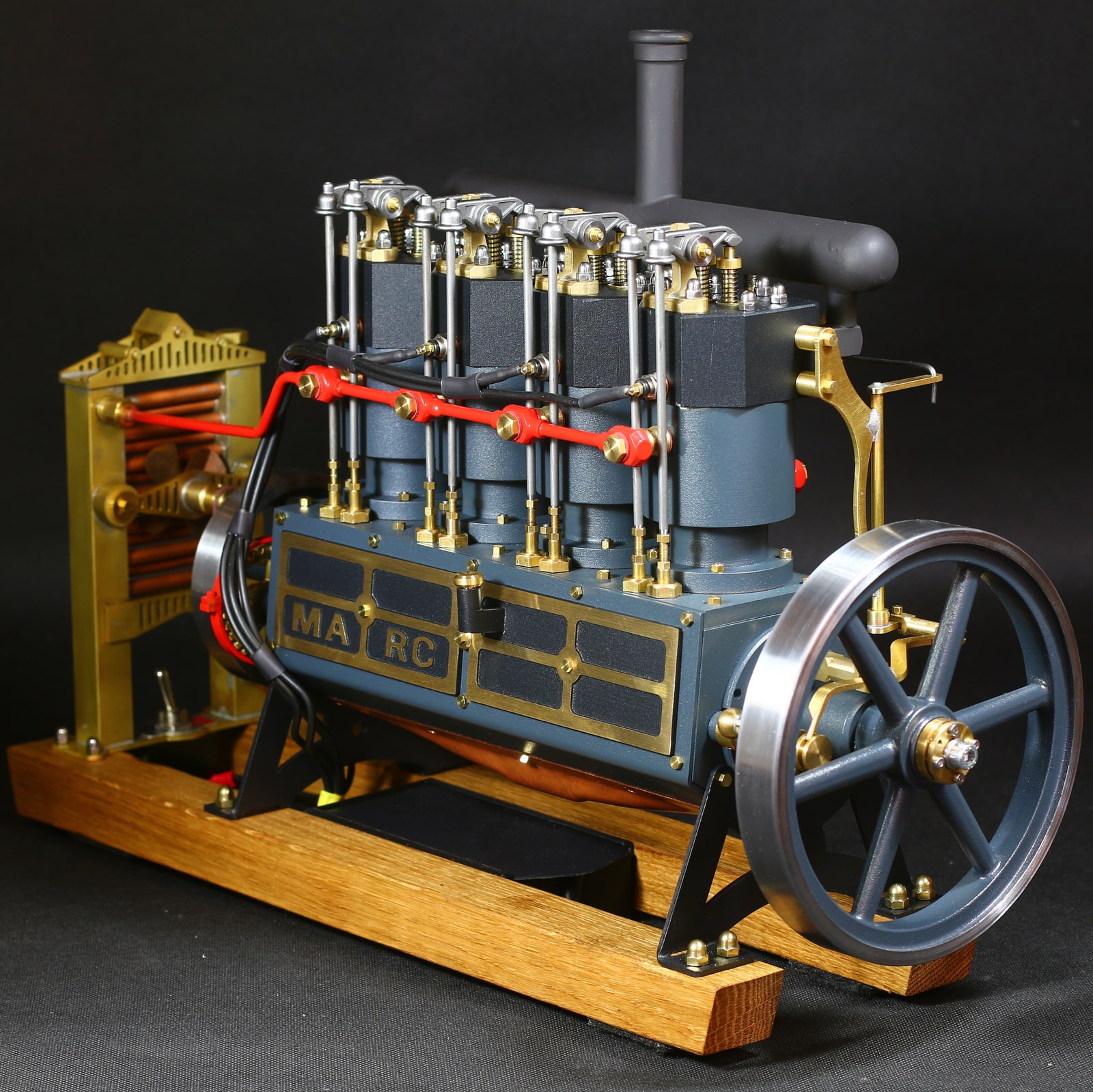
The 4-cylinder in-line engine "Marc" is based on a historical model. The model was a four-cylinder in-line engine that was manufactured by the American company Holt at the beginning of the 20th century. This engine was mainly used in bulldozers and tracked tractors. This engine was available in 2, 4 and 6 cylinder versions. In 1925, the Holt company became the Caterpillar company, which still exists today. The engine does not consist of a cast engine block, as was usual later, but still has individual cylinders. This design is visually very appealing and makes it possible to offer the engine as a material kit.
- Speed control via centrifugal governor
- Carburetor with adjustable throttle valve
- Cooling circuit with cooling water pump
- Cooler with fan
With the 4-cylinder in-line engine "Marc" material kit, you can build a fully functional combustion engine yourself. The material kit contains all the necessary parts including the ignition. The engine has a functioning speed control using a centrifugal governor. A cooling water pump pumps water through a radiator, where the cooling water is cooled down by the fan and then flows back into the cylinder jacket. The engine is equipped with glow plugs. The glow plugs come with four Batteries operated. All components for producing the ignition are included (batteries are not included).
Dimensions of the model combustion engine 'Marc':
- Height with wooden base: 310mm
- Length: 450mm
- Width: 180mm
- Piston diameter: 23mm
- Flywheel D.: 1x140mm 1x80mm
- Speed speed: 200-1000 rpm
- Weight: 9.1kg
The engine stands on two oak runners. The engine block is screwed together from milled parts. The base plate for the cylinders is made of steel, the bearing blocks that hold the crankshaft are made of aluminum. This unit is then provided with finished lasered and folded sheets. The cylinder sleeves are made of brass, the inside diameter no longer needs to be machined. The cylinder head and cylinder are included as material sections and must be machined on the lathe. The remaining components are mainly made of brass. The crankshaft is made from individual segments. No milling machine is required to produce the crankshaft either. It can be built entirely on the lathe. Further information can be found in our build report for the four-cylinder engine. The two flywheels are available in the quality we know. Both flywheels are made of cast steel.
The speed of this model is controlled via the carburettor. You can regulate the amount of air supplied. The carburettor is connected to a centrifugal governor via a linkage. This means you can set the engine to a desired speed, which is then maintained under load using the centrifugal governor.
Here you will find an extensive construction report of the four-cylinder internal combustion engine Marc< /a> with lots of pictures and additional texts.
Here you will find extensive assembly instructions for the combustion engine On the page you can see how you have to put all the manufactured parts together.
Here you will find extensive instructions for the Commissioning and operation of the four-cylinder engine Marc
All materials required to build the internal combustion engine "Marc" screws, nuts, springs and ignition parts are included in the kit. All milled parts are prepared so that they only need to be deburred and possibly drilled. To build the vertical stationary motor, a lathe, a drill and a gas burner for soft soldering are required. The following hand tools are also required (tap M2, M3, M4, M5, 6x0.75, M8x0.75, M10x1 die M2, M3, M5, M6x0.75, M8x0.75, M10x1 reamer 4H7 6H7, 8H7, 10H7) Files and a drill set are necessary. All you need to wire the ignition is a pair of side cutters, wire strippers and a soldering iron.
If you would like to find out in advance what steps you will take to make this internal combustion engine
have to be carried out, take a look at the construction report of the 4 cylinder combustion engine "Marc" material kit in our Bengs model building magazine. On this page you can see the illustrated report on how the stationary motor material set is processed.The scope of delivery includes:
- finished CNC milled milled parts
- Raw material for the turned parts
- Rough casting part for the flywheels
- 2 runners made of oak wood
- All required screws, nuts, gears and seals
- Drawings of the internal combustion engine "Marc" (36 sheets) and construction instructions (8 sheets)
- Glow plugs, cables, cable clamps, battery compartment for the ignition
- Laser parts for stands and fairings
Hersteller
Bengs ModellbauIm Kirchfelde 6
31675 Bückeburg
info@bengs-modellbau.de
Verantwortliche Person
Patrick BengsBengs Modellbau
Im Kirchfelde 6
31675 Bückeburg
info@bengs-modellbau.de
Login
Kunden Kauften auch

Freewheel bearing / needle bearing HF1012 with an inner diameter of 10 mm, an outer diameter of 14 mm and a bearing height of 12 mm. A freewheel bearing only transmits the force in one direction of rotation, in the other direction of rotation, the bearing runs freely and it there is no power transmission. We use these freewheel bearings to start our combustion engines. You build a holder for the cordless screwdriver and press the freewheel into the holder (note the direction of rotation).With the device you can bring the combustion engine to the speed of the cordless screwdriver when the engine starts and the As the speed increases, the freewheel slips over and the cordless screwdriver is protected. The freewheel bearing has the following dimensions inner diameter 10 mm outer diameter 14 mm Width 12 mm Weight 0.004 kg Outer ring with knurling in the outer ring
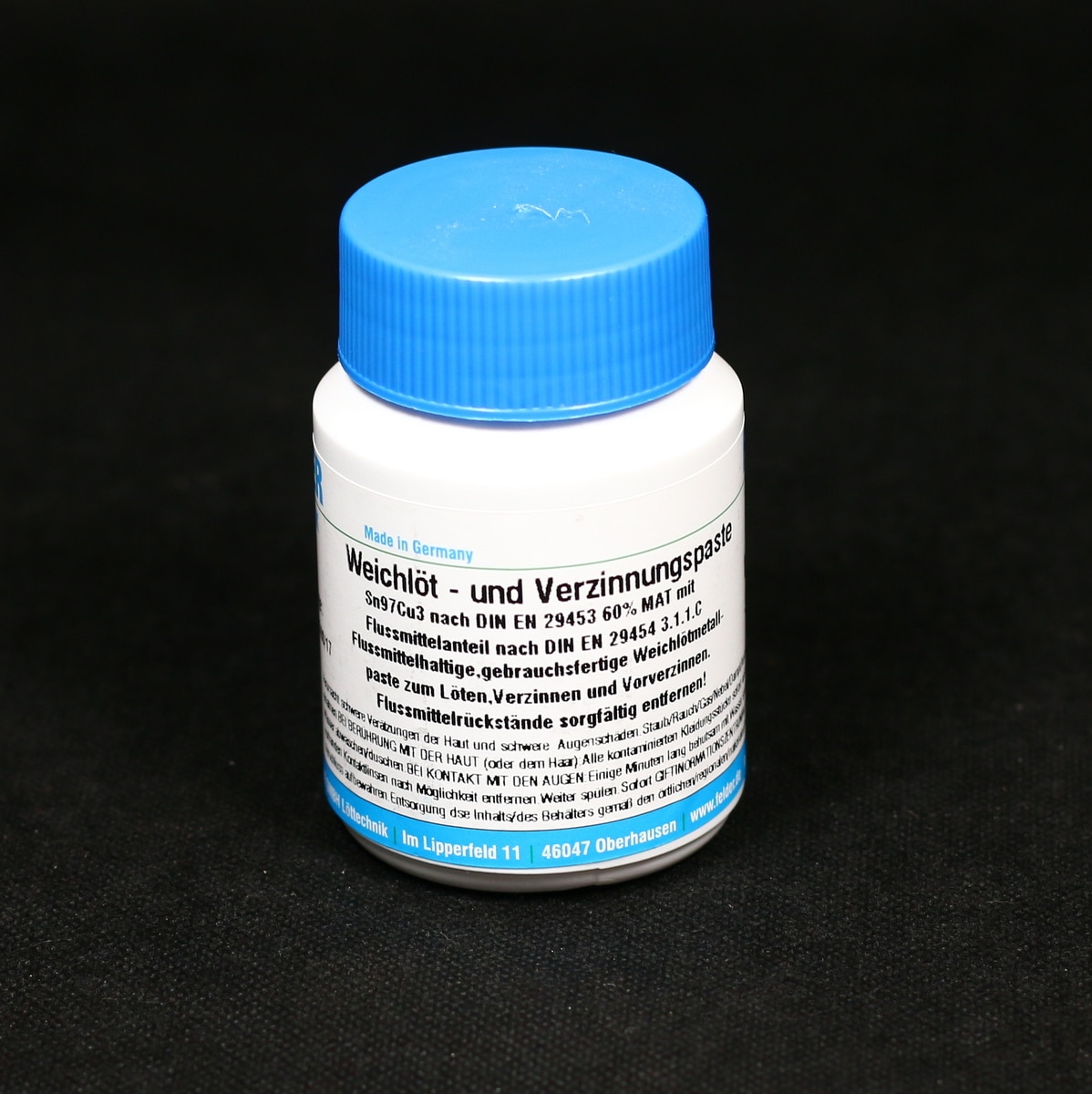
Soft soldering paste for brass, copper, steel and silver steel. The paste is applied thinly to the parts to be tinned and heated with a brazing lamp. For large-area soft soldering, it is optimal to tin- the parts beforehand. For example, we use the paste to pre-tine the cylinder and the mirror when constructing a model steam engine. The tinning paste can also be used optimally as a flux substitute. The soft soldering paste is excellently suitable as corrosion protection for steel parts. Bengs Modellbau uses the zinc paste for steel cylinders with a cooling water jacket. For example in the Flammenfresser Kurfürst. Stirring the paste before use is not necessary! The soft soldering paste may be diluted with water. Ready-to-use metal paste Contents: 50g Bottle with brush Click here for the modeling magazine: Soldering with soft solder paste and tin paste Soldering and tinning with soft soldering and tinning paste
Content: 0.1 Kilogramm (€106.00 / 1 Kilogramm)

These NiMH batteries can be charged with almost any charger for NiMH batteries. Depending on charging and usage behavior, these can be recharged up to 1,000 times. These batteries are specifically for devices with above-average power consumption. We use these batteries to operate the glow ignition for our internal combustion engines. With 3500 mA, this battery has enough power to keep the glow plug operating for a long time. We use this battery to operate the glow ignition for our combustion engine Little Karl.Rated voltage: 1.2 V Rated capacity: 3500 mAh Charging current max.: 1750 mA
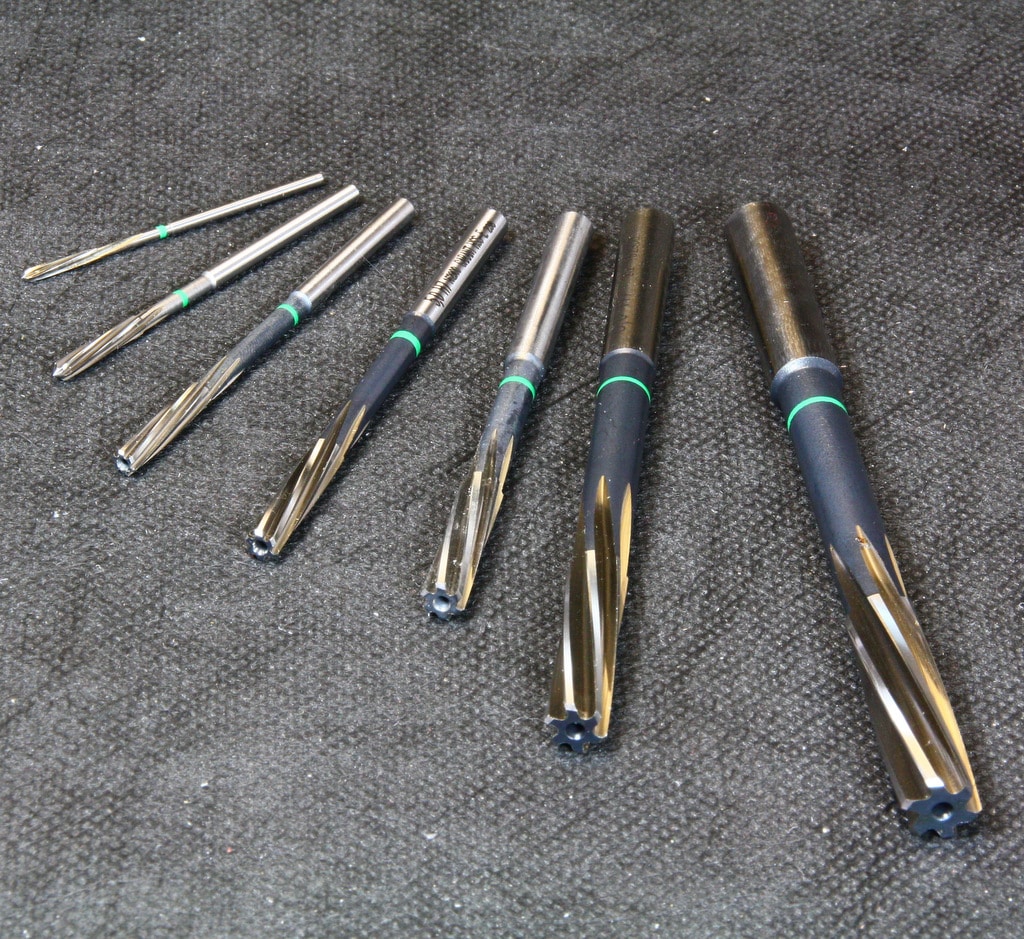
Machine reamers for the production of dimensionally accurate bores. By rubbing with a reamer, not only good shape and dimensional accuracy, but also good surface quality is achieved. This is of crucial importance when manufacturing sliding bearings in mechanical engineering and model building. The long cutting edges of the reamer have a left-hand twist, which causes the resulting chips to be discharged downwards when rubbing. Thus, a scratching of the bore surface by the resulting chips is avoided. Our machine reamers have industrial quality and can be used to grind drillings in steel, brass, copper, cast iron, aluminum and stainless steel. Please always use enough cutting oil when rubbing, which considerably increases the service life of the reamer. In model construction, these reamers are suitable for producing piston rod guides for steam engines, Stirling engines and flame eaters. The reamers are also ideal for producing bearing blocks with plain bearings or for producing cylinders with a very clean surface. If you produce the axis bore with a reamer for flywheels, the flywheel runs particularly round. Provided you have the flywheel without impact in the lathe. The machine reamers can be used both on a lathing machine and in a column drilling machine. With long cutting edges and link spiral Maximum roundness accuracy industrial quality These reamers are available: Reamer 1H7 / Shaft 1mm / cutting length 16mm Reamer 1,5H7 / Shaft 2mm / cutting length 21mm Reamer 2H7 / Shaft 2mm / cutting length 26mm Reamer 3H7 / Shaft 3mm / cutting length 29mm Reamer 4H7 / Shaft 4mm / cutting length 46mm Reamer 5H7 / Shaft 5mm / cutting length 57mm Reamer 6H7 / Shaft 6mm / cutting length 56mm Reamer 7H7 / Shaft 8mm / cutting length 71mm Reamer 8H7 / Shaft 8mm / cutting length 80mm Reamer 10H7 / Shaft 10mm / cutting length 91mm Reamer 12H7 / Shaft 10mm / cutting length 110mm Reamer 14H7 / Shaft 14mm / cutting length 112mm Reamer 15H7 / Shaft 14mm / cutting length 114mm Reamer 16H7 / Shaft 14mm / cutting length 123mm Reamer 18H7 / Shaft 14mm / cutting length 135mm Reamer 20H7 / Shaft 16mm / cutting length 145mm Reamer 25H7 / Shaft MK3 / cutting length 174mm Reamer 26H7 / Shaft MK3 / cutting length 178mm
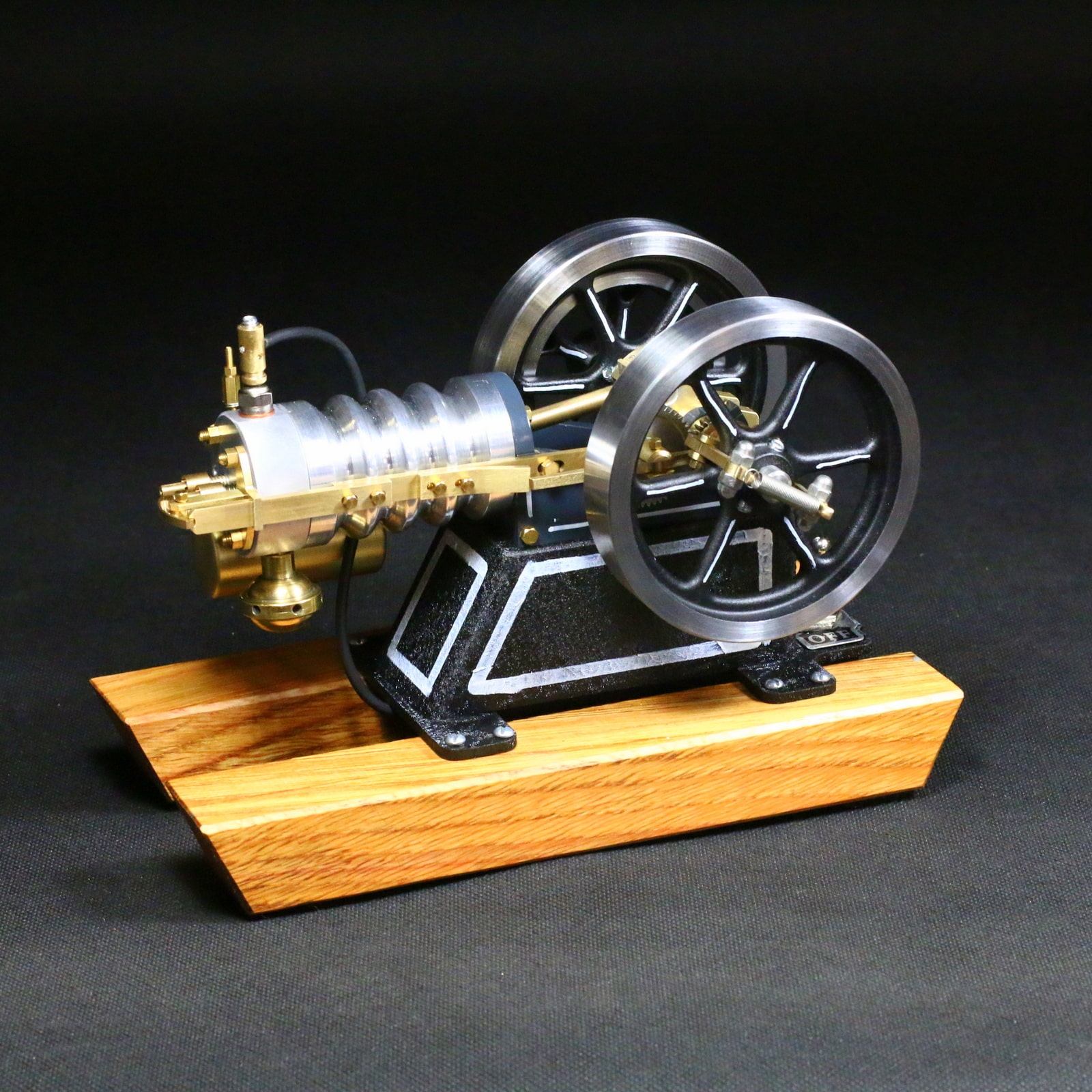
The combustion engine “Little Karl” is, as the name suggests, the small version of our popular combustion engine Karl. With this kit, particular emphasis was placed on the fact that it can be made in a small hobby workshop with a small lathe. Thanks to its simple construction, this model is also suitable for beginners in technical model making. In contrast to the large stationary engine Karl, this model does not have an ignition with a spark plug but rather a Glow plug. This circumstance makes both the construction of the model and its operation easier because the ignition timing does not need to be adjusted. Of course, this model also has speed control via Hit & Miss control. The combustion engine “Little Karl” with glow plug has a stable frame made of milled brass parts. The crankshaft is guided in two gunmetal plain bearings. The cylinder sleeve consists of a precision brass tube that no longer needs to be processed inside. An aluminum piston runs in the tube. The cylinder head and cooling jacket are also made of aluminum. Most other components such as the carburettor, tank, rocker arms and controls are made of brass. The entire motor is mounted on an aluminum base which in turn rests on two oak wooden runners. The two 80mm flywheels and the pulley are made of cast steel using the lost wax casting process and are of excellent quality. All materials required to build the combustion engine "Little Karl", such as screws, springs and ignition parts, are included in the kit. All milled parts are prepared so that they only need to be deburred and possibly drilled. All turned parts are included in the kit unmachined and must be manufactured according to the drawing. To build the Hit & Miss Motors requires a small lathe, a drill and a gas burner for soft soldering. The following hand tool is also required (tap M2, M3, M4, tap UNEF1/ 4 x 32, Dies M4, M6, reamer 3H7, 5H7, 6H7, 8H7) files and a drill set are necessary. All you need to wire the glow plug is a pair of side cutters, wire strippers and a soldering iron. You also need a baby battery with at least 3000 mAh. The battery is not included in the kit but can be ordered from us. If you would like to find out in advance which work steps you have to carry out when manufacturing this combustion engine, take a look at our Bengs model building magazine Construction report of the combustion engine "The Little Karl" with glow plug. On this page you can see the illustrated report on how the stationary motor material set is processed. Dimensions of the model combustion engine 'Karl': Height with wooden runners: 135mm Length overall: 200mm Width overall: 120mm Length without runners: 190mm Piston diameter: 20mm Flywheel D.: 80mm Speed: 600-1500 rpm Weight of the finished model: 1.8kg Hit & Miss Regulation With the hit & With this control you can limit the maximum speed of the engine. If the engine has reached too high a speed, a slide prevents the exhaust valve from closing. This means the engine runs freely. No compression can occur in the cylinder chamber and the engine neither sucks in fresh gasoline nor ignites the air-fuel mixture. The Hit & Miss regulation is called suspension regulation in German. The misfire control was mainly used in the USA by various companies for internal combustion engines from 1890 to 1940. The scope of delivery includes: finished CNC milled milled parts Raw material for the turned partsRough casting part for the flywheels 80mm Raw casting part for the belt wheel Two wooden runners made of oak All required screws, nuts, gears and sealing rings Drawings of the combustion engine "Little Karl" (24 sheets) and construction instructions (11 sheets) Switch, battery compartment, cable and glow plug (Battery Baby battery not included is available from us